Wednesday, August 19, 2015
48 arrested for rhino poaching in Namibia since June, says police
The Namibian Police Force (NamPol)'s Anti-Poaching Unit has since June this year arrested 48 people for alleged rhinoceros poaching crimes.
Furthermore, about 22 of those arrested have appeared in the Okahao Magistrate's Court in Omusati Region during the month of July this year, while an unspecified small number of suspects were released, pending further police investigations into their cases.
NamPol's Deputy Inspector-General for Operations, Major-General James Tjivikua revealed this in a media statement availed to Nampa here on Friday.
Tjivikua added that the majority of suspects were arrested in farming areas surrounding the Etosha National Park and villages in the Omusati Region, which are sharing borders with the Etosha National Park.
“All 48 suspected poachers were initially denied bail when they appeared in the Okahao Magistrate's Court in July 2015 and all were remanded in police custody with no option to post bail. However, some of the suspects brought formal bail applications before court and were eventually granted bail,” said Tjivikua.
According to him, so far, the police confiscated 66 rifles that were used by the suspects in the commission of the poaching crimes. These rifles were already sent for ballistic examination and the ballistic results linked some of the confiscated firearms to the crimes.
“In the Etosha National Park, I have visited the officials of the Ministry of Environment and Tourism, as well as members of the Namibian Police Force's Anti-Poaching Unit deployed at the park. They are all well and vigilant. My next step is the visit to Palmwag Conservancy areas as per programme,” explained the senior police officer.
In addition, Tjivikua also took the opportunity to call upon the general Namibian public to continue providing information pertaining to rhino poaching activities to NamPol, as such information will be treated with a high degree of confidentiality.
Tjivikua has also revealed the police is now offering a reward of N$60 000 to any person or persons for reliable information that would lead to the arrest of persons involved in rhino poaching activities across the country.
Source: Nampa

Saturday, July 25, 2015
10 elephant carcasses discovered in Zim trans-frontier game reserve
At least 10 elephants were killed during the past two months in the giant Gonarezhou national park as poaching reaches alarming levels in the Great Limpopo Trans Frontier Park.
It also emerged this week that over 700 people from the Chitsa clan were still occupying part of the sanctuary, hampering efforts to deal with poaching activities. The clan moved into the giant park during the height of the farm invasions and has since vowed to resist eviction, arguing that the land belongs to their ancestors.
Bodies of the killed animals were recovered this month with some of them being at an advanced stage of decomposition. All their tusks had been removed. Acting Masvingo police spokesman Assistant Inspector Nkululeko Nduna confirmed the development. “We are investigating cases of poaching in Gonarezhou where several animals especially elephants were killed,” he said. “So far no arrests have been made but investigations are in progress.”
Although no official comment could be obtained from the department of parks and wildlife, a highly placed source in the department told Zimbabwean that the poachers were allegedly using poisonous substances to kill the animals.
“As I speak now we have lost 10 elephants in just two months and our investigations point to the fact that the poachers were using poisonous substances to kill the animals. We are having problems dealing with poaching activities in the giant park because of the presence of invaders from the Chitsa Clan,” he said.
Poaching has reached alarming levels in the country’s national parks and Zimbabwe risks being expelled from the Convention on International Trade of Endangered Species CITES. Some 200 rhino have been lost since 2012 due to rampant poaching.
According to animal welfare groups, among them the Species Survival Commission and the International Union for the Conservation of Nature, this loss represents about 30 percent of the living rhinos in the country. Source: Zimbabwe Situation

Friday, July 24, 2015
Namibia launches new rhino protection initiative
Private rhino protection initiatives will start tomorrow, 24 July, with the training of the first seven recruits who would assist in the containing and exposing of the five syndicates so far identified by the Ministry of Environment and Tourism spearheaded by Minister Pohamba Shifeta.
“The time for talking is over. It is now time for action,” said an adamant Jofie Lamprecht, founding member of the Conserving Our Valuable Elephant and Rhino (COVER) organisation. The first recruits will be used on commercial farms and conservancies.”
Lamprecht’s statement falls right in line with the government’s steps to eradicate the poaching of rhinos and elephants in Namibia, with recent arrest made of alleged poachers from the five different poaching syndicates operating in Namibia.
Earlier this month, Shifeta informed the nation that 41 poachers were arrested, but told Informanté yesterday that the number of arrests have increased since then. “This is however not the end. Many more arrests will be made soon and the ministry will inform the public accordingly.”
COVER, consisting of many smaller organisations also involved in the conservation of animals in Namibia, held a meeting with Security Solutions Africa. “This company has the experience in combatting illegal rhino and elephant hunting and offered to train Namibians to capture these poachers,” Lamprecht said.
COVER aims to train trackers and anti-poaching units, as well as to promote advocacy for the legalisation of the sale of rhino horns and the use of Unmanned Aerial Vehicles (UAVs) for surveillance purposes. Lamprecht stated that the proper training of Namibians as anti-poaching units (APUs) is a necessity as they will face armed criminals that will shoot at them if threatened.
“These APUs will also consist of professional trackers and medics to ensure the team is ready for anything,” he said. Shifeta welcomed the training of Namibians against poaching, as long as it is done in good faith and within the legal framework of the country. However, he issued a warning to these companies that conducted the training.
“Recruits should be properly screened as to ensure that training is not conducted with members of one of the five poaching syndicates operating in Namibia,” he said. According to Lam-precht, the legalisation of the sale of rhino horns and ivory will help conservation, adding that government might submit a request in this regard to the Convention on International Trade in Endangered Species (CITES) which will meet in March next year.
 “This money can be ploughed back in the Game Products Trust Fund to be utilised again for conservation purposes such as training and equipment.”
COVER prides itself when it comes to transparency and honesty. The organisation has reported alleged wrongdoings by one of its members, Next Generation Conservation Trust.
Source: Informante, Namibia
“This money can be ploughed back in the Game Products Trust Fund to be utilised again for conservation purposes such as training and equipment.”
COVER prides itself when it comes to transparency and honesty. The organisation has reported alleged wrongdoings by one of its members, Next Generation Conservation Trust.
Source: Informante, Namibia

Sunday, July 5, 2015
More Zim baby elephants flown to captivity in Chinese zoos
HWANGE NATIONAL PARK, ZIMBABWE - After nearly 10 months in captivity in bomas inside the Hwange National Park, some of the 27 baby elephants, some lion cubs and one leopard which were captured by Zimbabwean authorities for export to Chinese zoos were on Saturday transported by road to Harare International Airport.
They are, as of today (Sunday), reported to have been loaded onto an Emirates Airlines aircraft bound for Dubai where a connecting 12 hour flight awaits them to China where they will be shared among two zoos. The exact number of animals moved is yet to be established. Newly found evidence suggests that 12 baby elephants and 2 lion cubs are already in China - having been flown out in two batches in December 2014 and January this year.
The elephants were transported by Western Transport, a long-established haulage company located close to the corner of Birkenhead Road and Josiah Chinamano Streets in Belmont heavy industrial sites in Bulawayo. It also operates in South Africa, operating a large fleet which trades as Wes-Trans Trucking and is registered in Gauteng.
 Some of the Western Transport trucks used to ferry the elephants to Harare last night
 A Western Transport truck loaded with containers inside which the baby elephants, aged between 2 and 5 at the time of their capture, will endure the journey to abusive captivity China.
Posted by: African Environmental Police
A Western Transport truck loaded with containers inside which the baby elephants, aged between 2 and 5 at the time of their capture, will endure the journey to abusive captivity China.
Posted by: African Environmental Police


Tuesday, June 30, 2015
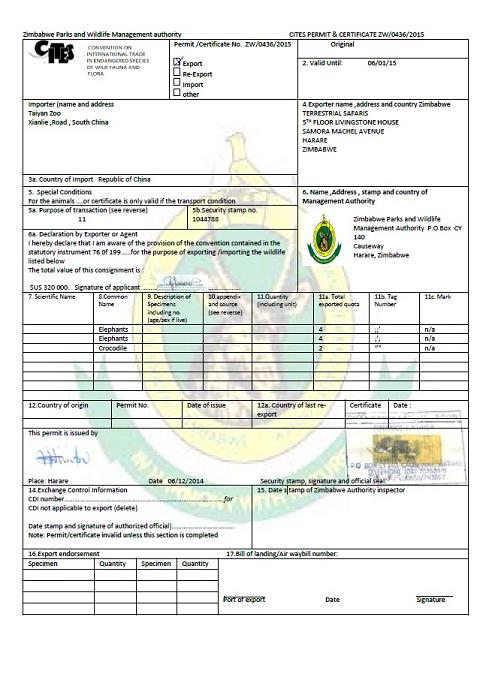
Zim uses suspect permits to exports 12 elephants, 2 crocs to Chinese zoos
 The first CITES permit, which has plenty of essential details missing, purports to show the export of 4 baby elephants from Hwange National Park, on 06 December 2014, to Kinjian Safari Park, located on Yinbing Road, in the Chinese city of Guangzhou. The export was arranged on behalf of the Parks and Wildlife Management Authority by Terrestial Safaris of 5th Floor Livingstone House, Samora Machel Avenue, Harare, Zimbabwe.
Monday, June 22, 2015
$6m for resuscitation as Gonarezhou loses more elephants
The Frankfurt Zoological Society (FZS), a Germany-based conservation organisation has released over $6 million towards the resuscitation of Gonarezhou National Park (GNP) to transform it into a commercially viable business.
Zimbabwe Parks and Wildlife Management Authority and FZS, signed a memorandum of understanding in 2007 that established Gonarezhou Conservation Project (GCP) as part of efforts to bring back the park to its previous glory. Under the deal, the German organisation would release over $1 million annually to resuscitate GNP until 2020.
Speaking to journalists after touring the park on Thursday, the conservation project leader Mr Hugo van der Westhuizen said the funding of Gonarezhou National Park had no strings attached. He said the organisation wanted to see Zimbabwe being able to manage its natural resources without external assistance in the future.
“On average, we have been funding Gonarezhou Conservation Project since the end of 2007 to the tune of $1 million per year. What we want is to see Gonarezhou being able to raise enough money to fund itself so as to motivate its workers based here. Ever since the project started, we established so many camps in the park and more people from different countries are making bookings,” he said.
Mr Westhuizen said community involvement, especially chiefs and village heads in the project, had seen improved anti-poaching programmes in an area that had seen poachers from Mozambique wiping off rhinoceros. He said plans were afoot to reintroduce rhinoceros in the park.
Besides establishing camping sites, an electric fence around the 5 053 square kilometre-area has been erected; eight all-terrain Land Cruiser Trucks, a UD eight-tonne truck; brick making machine; tractors; motorised grader and bicycles have been bought using the funds.
He said poachers were now targeting jumbos by poisoning them with termic, a poison used by tobacco growers, which they lace on fruits favoured by the animals. According to latest statistics at the park, 11 elephants were shot, nine poisoned by poachers, while 11 died of natural causes.
Reports also say hyenas were being poisoned as the poachers were after their skins that were used for ritual purposes in Mozambique.
“With the threat of ivory poaching ever growing and the park being particularly vulnerable through its long boundary with Mozambique and high elephant population, much attention has been focused on increasing security along this vulnerable stretch over the last two years.Permanent ranger pickets have been built, the border road has been cleared of vegetation to allow access to management vehicles and additional rangers recruited and trained – with the emphasis on employing staff from villages in close proximity to the Gonarezhou to ensure benefits also accrue to local communities,” said Mr Westhuizen.
The conservation project supports 39 schools in a 10 km radius of the park. Gonarezhou National Park in south eastern lowveld is the second largest wildlife sanctuary after Hwange National Park and was established in 1975. It is part of the Great Limpopo Trans-frontier Park, which straddles the borders of Zimbabwe, Mozambique and South Africa.
Source: Herald

Tuesday, June 16, 2015
Zim relocates 5 black rhinos to Botswana
HARARE – Zimbabwe loaded five black rhinos onto a plane bound for Botswana on Wednesday, its first such exports since the 1990s, as part of conservation efforts amid an increase in poaching in southern Africa. The animals were secured in crates loaded onto a camouflaged Botswana Defence Force (BDF) plane at the Buffalo Range aiAirport near Chiredzi, a town about 430km southeast of the capital, Harare. The exports follow the relocation of rhinos to Botswana from South Africa.
“We agreed that we’d send 20 black rhinos to them as part of conservation efforts within the region,” Zimbabwean Environment Secretary Prince Mupazviriho said in an interview. The remaining rhinos will be transported at a later date. Botswana has become a safe haven from poachers for the animals.
Rhinos are killed for their horns, which are ground into powder and sold as a putative cancer cure in Vietnam and China. Zimbabwe last exported them in the early 1990s, with Australia the destination, according to official records from the Ministry of Environment. A black rhino bull was exported to Botswana in the early 2000s.
The animals will be relocated to the Moremi Game Reserve, which was found to be suitable and where “the rhinos would be adequately protected post-release,” said Mark Saunders, the executive director of the Malilangwe Trust, which supplied the rhinos.
A record 1 215 rhinos were killed in South Africa last year, with the majority hunted in Kruger National Park. The country, home to most of the world’s rhinos, has relocated at least 100 to neighbouring states following discussions with Botswana and Zambia.
Male black rhinos can weigh as many as 1 400kg, while females are about 900kg in size, data on Save the Rhino’s website show. There are about 700 rhinos in Zimbabwe, which plans to release 40 into the Gonarezhou reserve, a 5053 square-kilometer park where they vanished because of poaching in the early 1990s.
Authorities are boosting manpower in the area as at least 25 elephants have been killed there for their ivory this year. The illicit global trade of wildlife is as worth as much as P100 billion, according to London-based Chatham House.
Source: Online
Subscribe to:
Posts (Atom)